
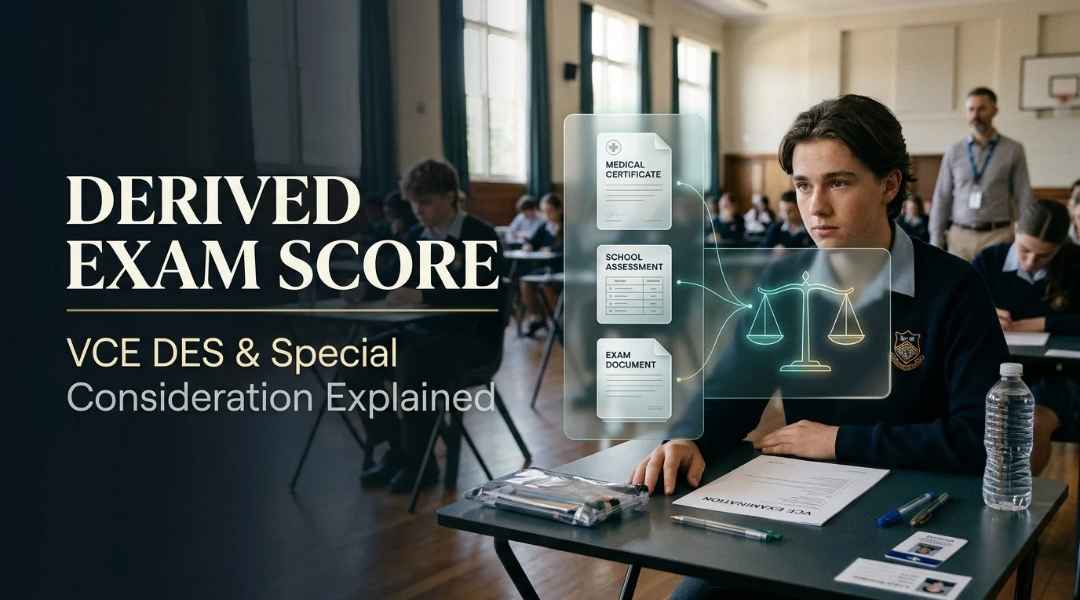
Derived Examination Score (DES) / Special Consideration Explained
If you’re sick or something goes wrong around a VCE exam, the Derived Examination Score is how Victoria makes sure your ATAR reflects what you actually know. A DES replaces an exam result that doesn’t reflect your ability. The process is fair, but it has firm deadlines and some limits worth knowing before you need it.
Table of Contents
What a DES is
A DES is a form of special provision from the VCAA. It covers students significantly affected by illness, injury or personal trauma at the time of a VCE exam, including students who can’t sit the exam at all.
How the VCAA calculates it
The VCAA works out a range of possible scores from your other results. These include your moderated school-based assessments, your GAT scores, any other exam scores in the same subject and an indicative grade from your school. The weighting of each comes from comparing these predictors with the actual exam results of all students who didn’t apply. The two graded school-based assessments carry the most weight.
The most important rule is that the VCAA only uses the DES if the highest possible derived score is higher than the score you actually achieved. Applying can’t lower your result.
How a DES affects your ATAR
There’s no special adjustment to your ATAR. If approved, the DES becomes your exam score, which goes into your study score as usual. VTAC then scales that study score and calculates your ATAR in the normal way.
How to apply
- Tell your school as soon as something happens. If you’re sick, see a doctor on the day if you can.
- Get independent evidence, such as a doctor’s report. The VCAA requires this before the deadline.
- Submit a separate application for each exam affected. The closing date for each is listed on your Student Examination/Assessment Timetable.
- Your school lodges the application, and the VCAA, not your school, decides on it.
What a DES can’t do
A DES only affects exam results. It doesn’t change your coursework or school-assessed task scores, and you can’t apply for one for the GAT itself. Because it’s calculated from your other results, it reflects how you were performing before the exam. Weak school-based results lead to a modest DES.
It’s also separate from VTAC equity schemes. Those schemes recognise longer-term disadvantage by adjusting your selection rank for particular courses. A DES fixes one exam result, and you can apply for both if both apply to you.
For example: a student gets gastro the night before their Chemistry exam and scores well below their usual level. Their SAC results, GAT and the school’s indicative grade all point higher. If the VCAA approves their application, the derived score replaces the low exam mark, and their study score and ATAR are calculated as if they’d performed at their usual level.
The NSW version: illness and misadventure
NSW handles this through NESA’s illness and misadventure process. As in Victoria, you submit a separate application with evidence for each exam affected. If it’s safe, attend the exam and tell the presiding officer when you arrive. If your application is declined, you keep the mark you achieved.
Students whose applications are upheld don’t receive bonus marks. Their mark is recalculated instead. In 2025, 4,301 students applied, about 6% of HSC exam students, and 83% of exam components were upheld.
The Bottom Line
A derived examination score protects your ATAR when illness or trauma affects an exam, but only if you apply properly and on time. Tell your school straight away, get independent evidence on the day and check the deadline on your exam timetable. Once results are out, you can try our ATAR calculator with your study scores to see where you’re likely to land.